01 / 06
Knowledge assistants
Give your team fast, grounded answers from approved documents and internal knowledge.


RBQ Technology / AI Engineering & Integration
From secure knowledge assistants to connected business systems, we design and integrate AI around your real workflows—with measurable objectives and human oversight.
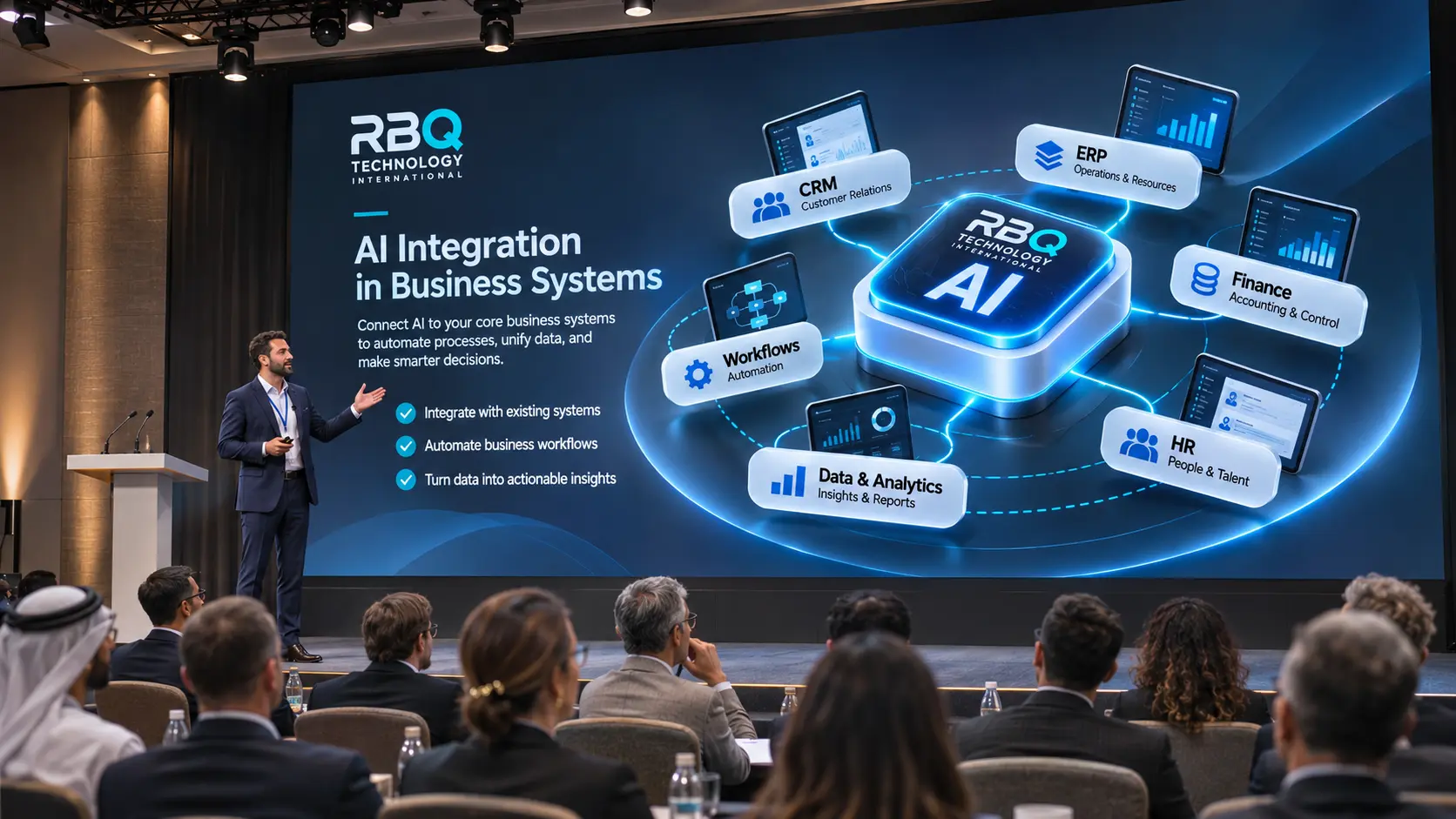
01 / What we build
We engineer practical AI capabilities around the way your business already works—not the other way around.
01 / 06
Give your team fast, grounded answers from approved documents and internal knowledge.
02 / 06
Bring AI into existing applications, APIs and daily business processes.
03 / 06
Extract, classify and organize information from documents for human review.
04 / 06
Reduce repetitive work while keeping critical decisions in the right hands.
05 / 06
Design for permissions, traceability, quality checks and responsible operation.
06 / 06
Launch with documentation, monitoring plans and clear ownership.
02 / The opportunity
AI engineering turns language models, business data and software integrations into useful applications. The goal is not to add AI everywhere; it is to solve a specific operational problem responsibly.
See business examples ↗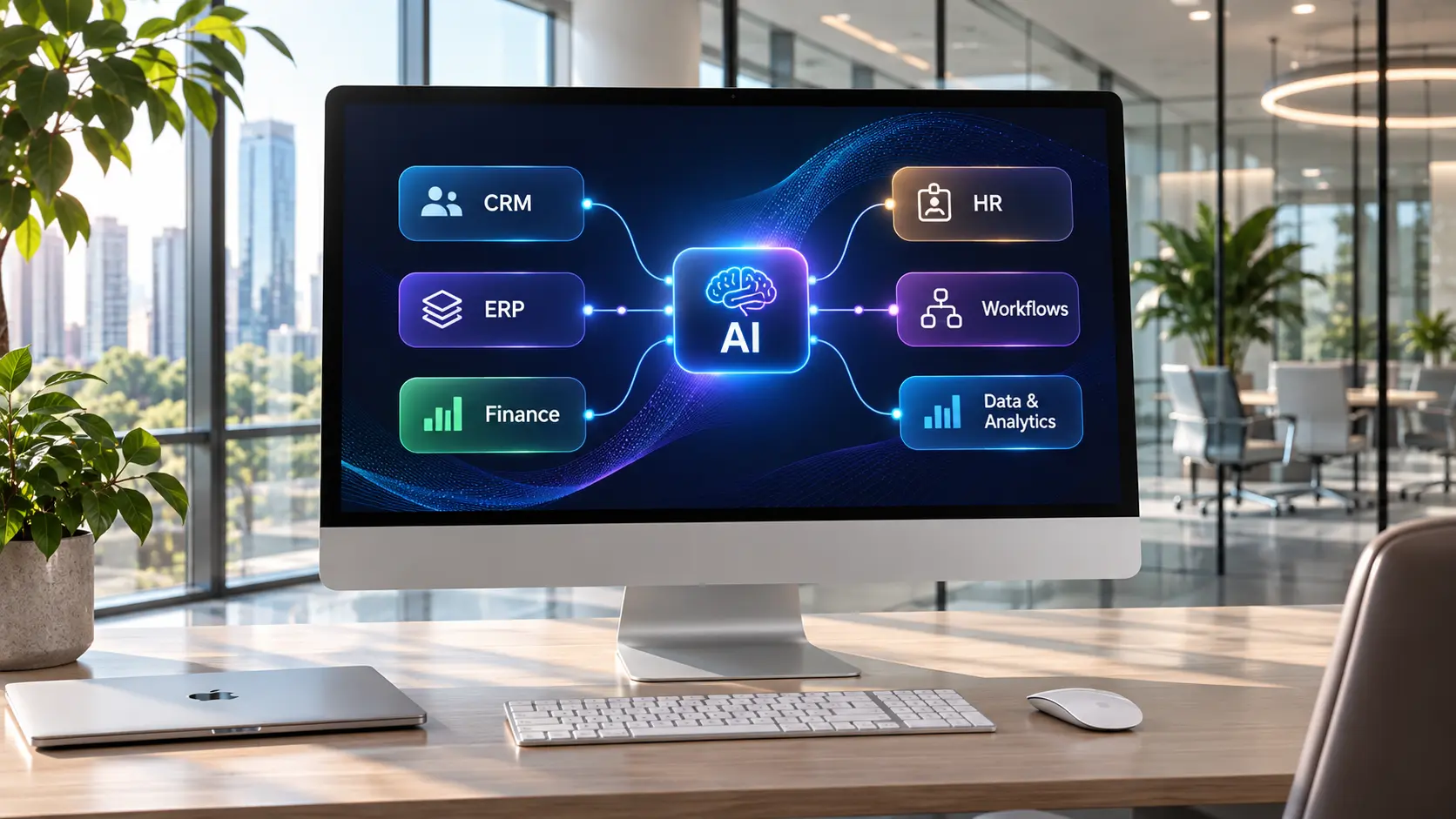
03 / Integration first
AI becomes useful when it connects to real business context. We bring your documents, data and tools into focused workflows that support better decisions and faster execution.
Let’s discuss your systems ↗04 / Real applications
Practical applications shaped around your teams, information and business processes.

Find relevant guidance, prepare responses and keep people in control of customer conversations.

Turn incoming documents and routine requests into structured information ready for review.

Make expertise easier to discover while respecting access rights and document permissions.
05 / Our approach
A clear process designed to reduce uncertainty and make each decision visible.
Understand the people, workflow, data and business outcome before choosing the technology.
Build a focused prototype and test usefulness, accuracy and practical limitations.
Integrate systems, define permissions and put review and evaluation mechanisms in place.
Prepare handover, monitor performance and refine the experience with real feedback.
06 / Engineering foundation
We choose technologies to suit your needs, security expectations and existing infrastructure—without unnecessary complexity.
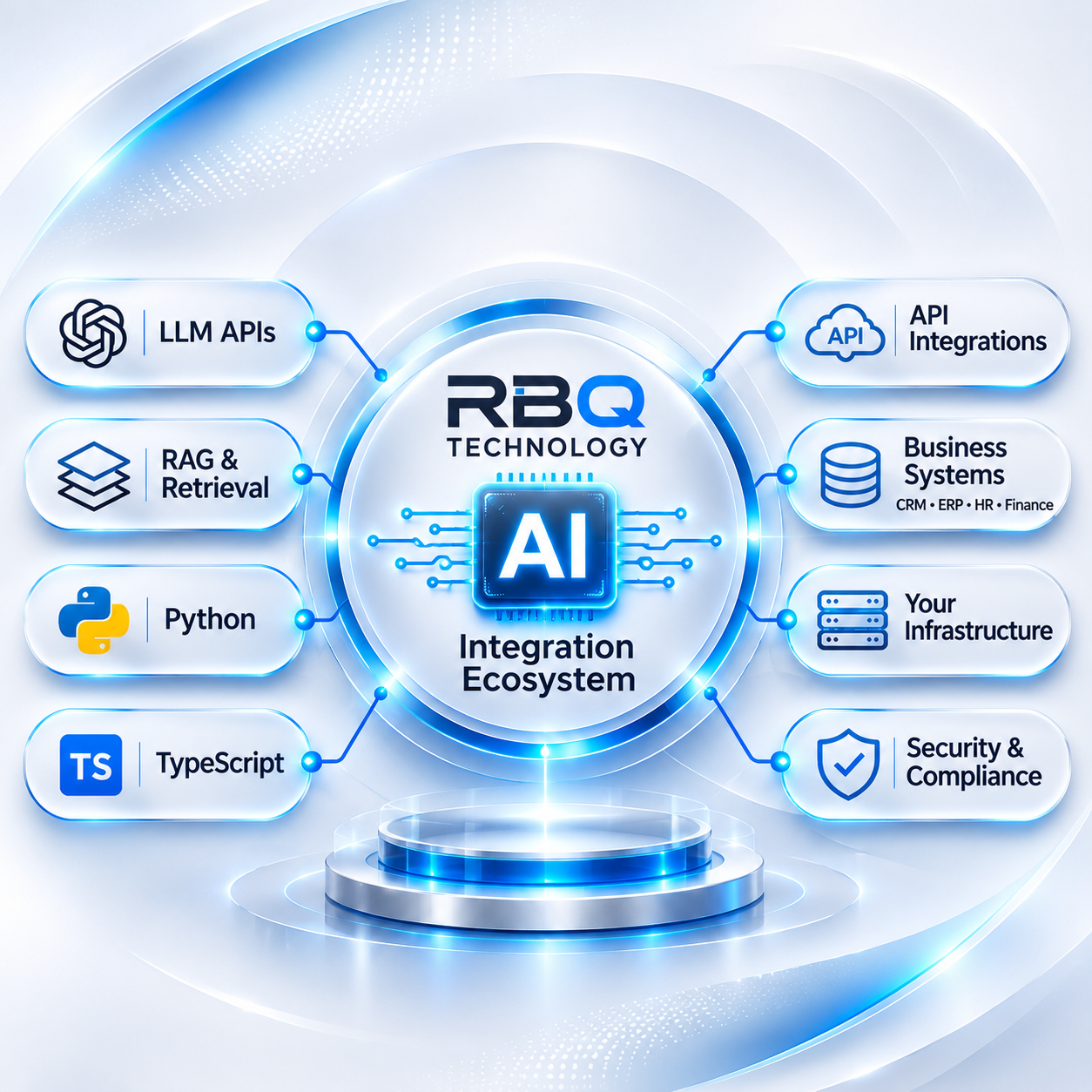
07 / The business case
AI integration for companies is not about adding another chatbot. It is about improving how work moves through your existing tools—with measurable goals, appropriate safeguards and people accountable for decisions.
Reduce repetitive searching, sorting, routing and drafting so your employees can focus on customers and higher-value work.
Connect approved company documents and knowledge bases to permission-aware AI assistants that cite their sources when supported.
Bring together CRM, ERP, support platforms, document repositories and approved APIs without automatically replacing existing software.
Define access rules, human approvals, evaluation criteria and monitoring before moving sensitive workflows into production.
Start with one workflow and a clear success metric—not an expensive, company-wide experiment.
08 / AI integration examples
Every company has different systems and constraints. These examples show where AI may help, subject to data quality, integration access and validation.
Retrieve approved answers from your knowledge base, summarize support tickets and draft replies for agent review.
Summarize interactions, suggest next steps and prepare CRM updates with appropriate authorization and oversight.
Classify invoices and extract fields for validation before information reaches accounting or ERP workflows.
Search policies, route internal requests and assist with onboarding while respecting role-based permissions.
08 / Invest with a plan
The best AI investment starts with a costly, frequent or frustrating business process. RBQ Technology can help assess feasibility, connect the right systems and define what success should look like before expanding.
09 / What you receive
A useful AI project needs more than a demo. Scope and deliverables are agreed during discovery, based on your infrastructure, risk profile and business goals.
Workflow mapping, feasibility review, integration requirements and a realistic implementation roadmap.
A tested assistant, document workflow or connected AI capability built for the agreed use case.
Permission boundaries, evaluation criteria, error handling and appropriate human-review steps.
Deployment preparation, operating documentation, monitoring recommendations and team onboarding.
10 / Choosing the right starting point
You do not need perfect data or a large transformation budget to explore AI. You do need a defined problem, responsible access to information and a way to evaluate results.
Not sure where to start? We can help prioritize use cases before recommending tools or models.
Discuss your starting point ↗11 / Questions business owners ask
AI integration connects artificial intelligence to existing company data, applications and workflows. Examples include knowledge assistants, document processing, CRM support and human-reviewed automation. The right solution depends on business needs, access permissions and technical feasibility.
It may reduce time spent finding information, drafting routine responses, classifying documents and transferring data between systems. Actual benefits should be measured against a baseline during a controlled pilot.
Often yes, if your CRM or ERP offers suitable APIs, approved connectors or supported integration methods. RBQ Technology first assesses system capabilities, data access, permissions and security requirements.
Usually not. A well-scoped AI integration can work alongside existing applications. Replacement is considered only if technical or business constraints make it necessary.
Potentially. We assess document sensitivity, access controls, hosting choices, retention policies and retrieval permissions before recommending an approach. Sensitive data requires additional safeguards.
Retrieval-Augmented Generation (RAG) lets an AI assistant retrieve relevant content from an approved knowledge source before generating a response. It can help employees find policies and documentation, but answers still require testing and appropriate oversight.
We plan for least-privilege access, authentication, data handling rules, logging, testing and human review where appropriate. Specific safeguards depend on your systems, risk profile and applicable requirements.
Pricing depends on workflow complexity, number of integrations, data preparation, hosting, model usage, security requirements and ongoing support. A discovery phase can define a realistic scope and estimate.
Timing varies with integration access, data readiness, approvals and scope. A focused proof of concept can help establish feasibility before committing to a production rollout.
Track a baseline and compare time spent, process throughput, error rates, quality, user adoption and operating costs after deployment. Avoid assuming savings before results are verified.
Yes. Starting with one high-value workflow often makes it easier to test accuracy, train users, manage risk and decide whether broader deployment is justified.
Contact RBQ Technology with your current systems, the workflow you want to improve and your desired outcome. We can discuss an initial assessment and potential next steps.
A chatbot is usually a conversational interface. A custom AI integration can also retrieve approved data, interact with CRM or ERP systems, process documents and support workflows. The required architecture depends on the actions, security controls and reliability your business needs.
Hosted models can simplify initial deployment, while private or self-hosted options may offer different controls over infrastructure and data handling. The right choice depends on data sensitivity, model quality, operational cost, latency and your compliance obligations.
Use approved knowledge sources, retrieval when appropriate, carefully designed instructions, testing against real scenarios, quality monitoring and human review for high-impact outputs. No approach eliminates all errors, so define when the system must defer or escalate.
RBQ Technology / Let’s build what matters
Tell us what slows your team down. We’ll explore where thoughtful AI integration can make a real difference.
Start a conversation ↗